

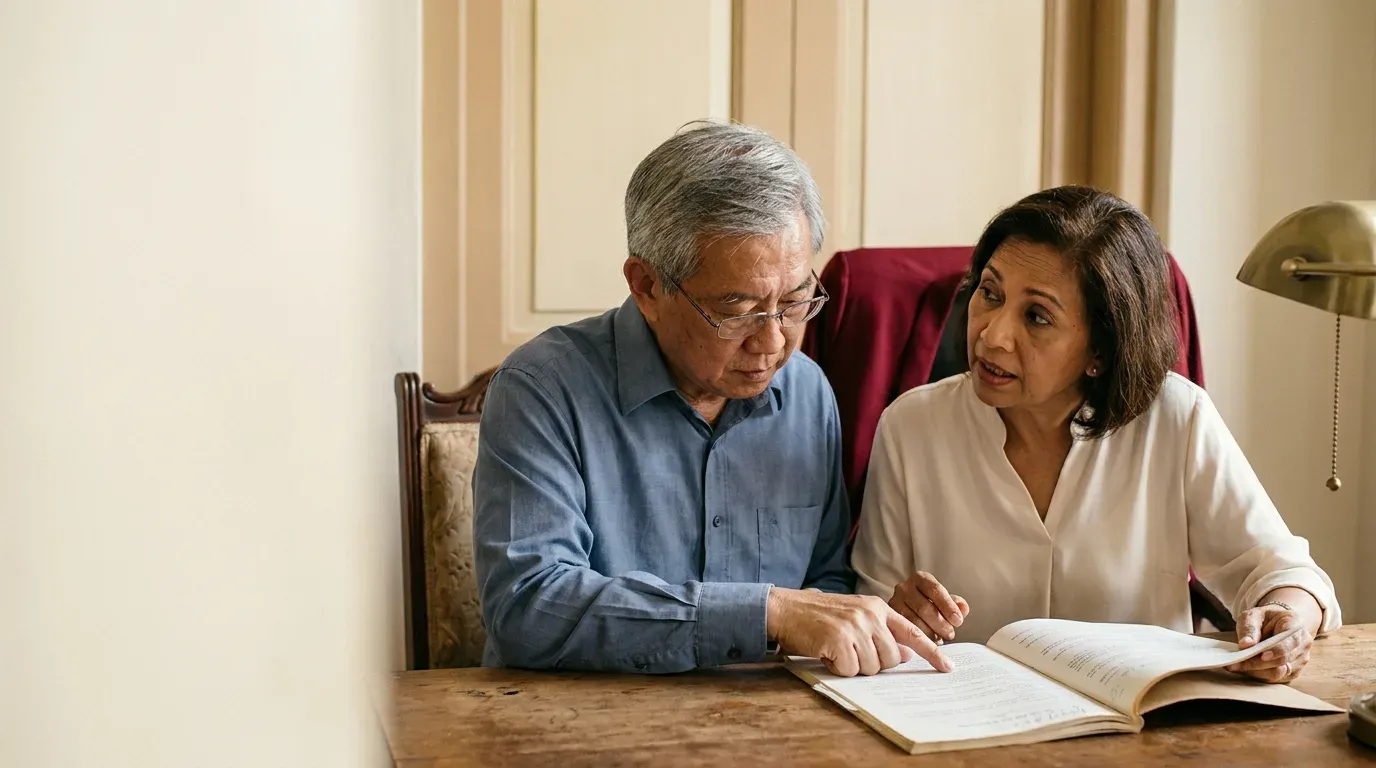
You and your spouse agree the marriage is ending. Neither of you wants a contested trial. Neither of you wants to hand the whole thing over to a court mediator on one fixed day either. You want a process where two lawyers work with you, not against each other, to land a full settlement. That is what a collaborative divorce in Singapore is for. I’m Wahab, and while this track is less common here than mediation, it is a real option worth understanding.
What Collaborative Divorce Actually Is
Collaborative divorce is a settlement process where both spouses hire their own collaboratively-trained lawyers, and all four people (the two of you and the two lawyers) sign a participation agreement. The key term in that agreement is the disqualification clause: if the process breaks down and the matter goes to litigation, both lawyers withdraw. Neither can represent their client in court afterwards. Each side has to start over with new counsel.
That sounds odd the first time you hear it. The reason it works is that it aligns everyone’s incentives toward settlement. Your lawyer is not fee-motivated to keep the dispute alive, because if the case ends up at the Family Justice Courts, they lose the client entirely. In my practice, that single clause changes the tone of every meeting.
The underlying divorce still runs through the Family Justice Courts under the Women’s Charter 1961. Collaborative divorce is not a separate legal regime. It is a private settlement framework that produces a consent order, which you then file with the court.
How It Differs from Mediation
People confuse collaborative divorce with divorce mediation in Singapore. They are both settlement processes, but the machinery is different.
| Feature | Mediation | Collaborative Divorce |
|---|---|---|
| Who runs the room | One neutral mediator | Both lawyers, working jointly |
| Who gives legal advice | Each lawyer, privately | Each lawyer, openly in four-way meetings |
| Typical format | One day, often a full caucus | Series of joint meetings over 2 to 6 months |
| If it fails | You go back to the court track with the same lawyer | Both lawyers withdraw; you restart with new counsel |
| Neutral experts | Rare | Common (financial neutral, child specialist) |
Mediation is faster and cheaper in the simple cases. Collaborative divorce is a slower burn that tends to produce more tailored settlements because you have room to bring in experts (a financial planner to model CPF and retirement splits, a child specialist to help design an access schedule the kids will actually live with).
For the broader menu of options outside a contested trial, see 6 things to know about alternative dispute resolution for divorce in Singapore.
Who This Process Actually Suits
Collaborative divorce is not for everyone. It works best when:
- You both want a negotiated settlement, not a day in court. If one of you is itching to be vindicated by a judge, this process will fail early.
- The finances are complex enough to need experts. Businesses, multiple properties, trust assets, overseas CPF or pension interests. A mediator’s one-day session often cannot work through these; a collaborative process gives you the time.
- The children’s arrangements matter more than the money. When a carefully designed parenting plan is the point, the child specialist in a collaborative team is worth more than any court-ordered access schedule.
- Both of you can afford two lawyers across 3 to 6 months. This is real. I’ll return to cost below.
- There is no safety issue. If there is coercion, family violence, or controlling behaviour, collaborative divorce is not safe. A protective order through the Family Justice Courts is the right first step, not a settlement meeting.
In my practice, collaborative divorce has worked well for couples running a family business together, for mixed-nationality marriages with overseas assets, and for long-married couples where the parenting plan needed a level of care an ancillary-matters hearing would not have given it. It has not worked where one party hired a collaborative lawyer to perform cooperation while continuing to hide income.
What a Collaborative Process Looks Like
There is no fixed statutory procedure, but a typical collaborative divorce in Singapore runs roughly like this:
- Each spouse hires a collaboratively-trained lawyer. In Singapore the pool is small but growing. Ask whether your lawyer has formal collaborative training, not just mediation experience. They are different skills.
- The four of you sign a participation agreement. This is the document with the disqualification clause. Everyone commits in writing to disclose fully and to not threaten litigation as a negotiating tactic.
- Neutral experts are retained, jointly. A financial neutral produces one set of numbers that both sides agree on. A child specialist meets with the kids and reports back on what kind of arrangement will work. Both of you pay half.
- Four-way meetings. Usually 3 to 8 of them, spaced across a few months. Each meeting has an agenda. The lawyers take turns leading. Homework (gather this statement, talk to this adviser) goes between meetings.
- Drafting the settlement. The two lawyers jointly draft a settlement agreement and, alongside it, the draft consent order for the custody, maintenance, and matrimonial asset division terms.
- Filing with the Family Justice Courts. You file the divorce papers (typically on the agreed ground, whether that is three years’ separation with consent or a one-side-only ground) and ask the court to record the consent order on ancillary matters.
The whole thing usually runs 3 to 6 months from first meeting to filed consent order. Sometimes faster if the facts are simple.
What It Costs, and What Happens If It Fails
Cost, honestly, is higher than mediation and lower than a fully contested trial. A collaborative divorce for a matter of moderate complexity (one HDB flat, two CPF accounts, one business interest, two children) typically runs in the range of S$12,000 to S$30,000 per side for legal fees, plus shared costs for the neutral experts of around S$3,000 to S$8,000 split between you. A contested ancillary-matters trial on the same facts can easily run S$40,000 to S$80,000 per side and take 12 to 18 months.
The failure case is the one people should think about before they start. If collaborative breaks down (one side refuses disclosure, or decides they want to litigate after all), the disqualification clause bites. You and your spouse both lose your current lawyers and have to start over. That risk is real and should be costed in.
In the two collaborative matters I’ve been involved with in recent years, neither failed, but I have watched the clause do its job: in each case, when negotiations stalled, the fact that switching lawyers would cost both sides another S$10,000 in onboarding was what kept everyone at the table. If you’re choosing between this and the court-annexed mediation track, see also mediation versus litigation in divorce for the contrast.
What to Do Next
Three things to take from this. One: collaborative divorce in Singapore is a real option, but the pool of trained lawyers is still small, so ask about training directly. Two: it suits complex facts or child-centred matters where a one-day mediation would not do justice to the detail. Three: the disqualification clause is the whole point. If you don’t trust the other side to take it seriously, pick a different track.
If you’re weighing collaborative divorce against mediation or a contested hearing, the first ten minutes with me are free. Book a Divorce Discovery Session or read more about mediation and arbitration. We’ll talk through your specific facts and tell you honestly which track is the right starting point. English, Malay, Tamil, or Vietnamese.